

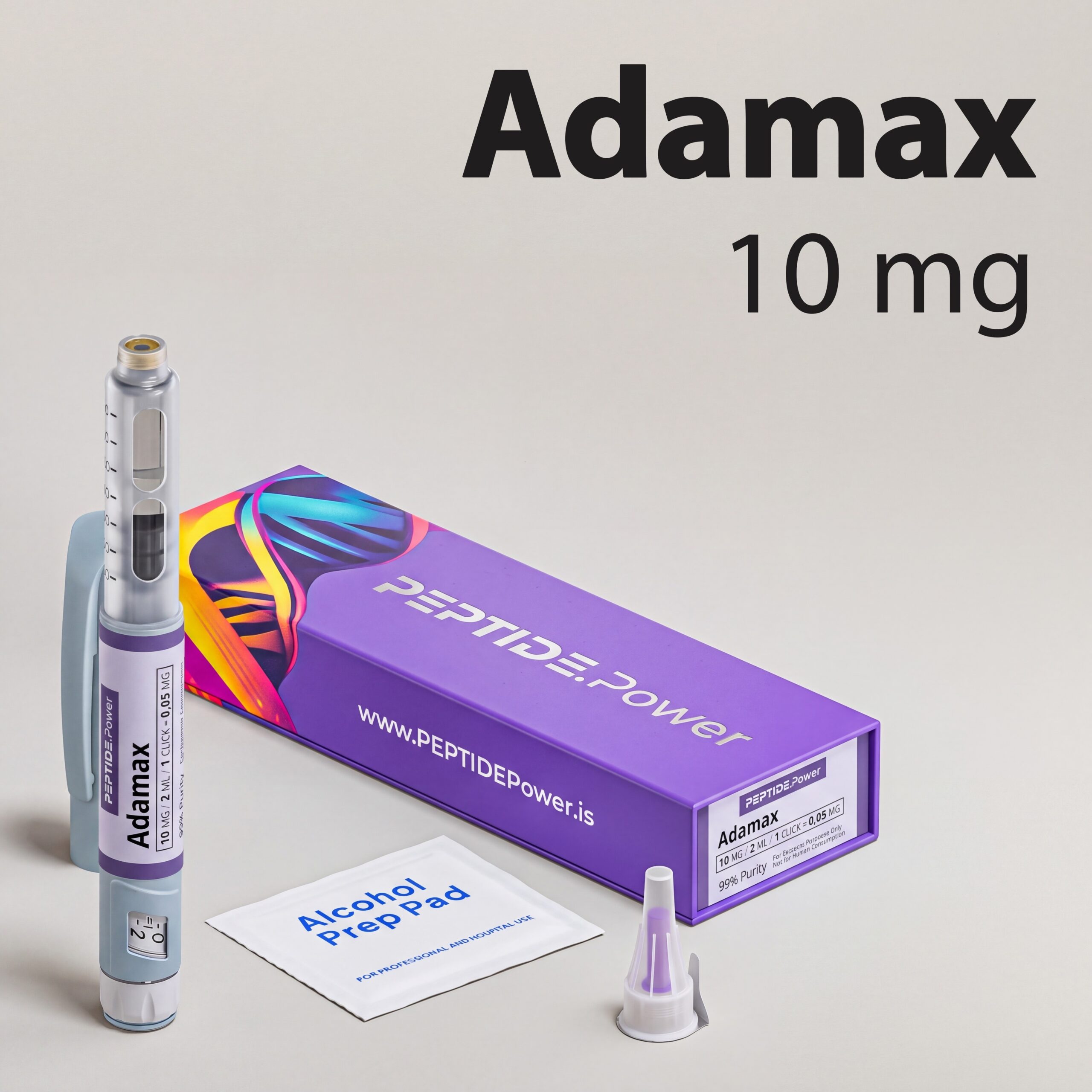


Adamax
Adamax is a synthetic research peptide designed as an adamantane-modified analogue of Semax, the N-acetyl heptapeptide derived from ACTH(4-10). Structural modification with a C-terminal adamantane amide is explored in peptide chemistry for enhanced lipophilicity and metabolic stability. Intended strictly for laboratory investigation of ACTH-fragment analogues.
$74.99
Adamax - Adamantane-Modified Semax Analogue
Investigated for possible engagement of neurotrophic signaling pathways in rodent cortical and hippocampal research models
C-terminal adamantane cage is studied for increasing molecular lipophilicity and passive membrane diffusion in peptide research
N-acetyl and adamantane amide groups are examined as dual modifications intended to slow proteolytic breakdown
Positioned within the Semax-family of peptides studied in animal models of attention and memory consolidation
Retains the core MEHFP motif, serving as a candidate for melanocortin receptor interaction and binding studies
Of interest in experimental neurology for probing modulation of inflammatory and apoptotic markers in injury models
Serves as a structure-activity relationship tool isolating the adamantane moiety's contribution to receptor binding and uptake
Defined formula C50H69N11O11S, monoisotopic mass 1031.49 Da and [M+H]+ 1032.497 support LC-MS identity verification in analytical research
Description
Adamax is a synthetic research peptide structurally based on the Semax heptapeptide (Met-Glu-His-Phe-Pro-Gly-Pro), modified with an N-terminal acetyl group and a C-terminal adamantane amide. With a molecular formula of C50H69N11O11S and a molecular weight of ~1032.2 g/mol, Adamax represents a lipophilic analogue designed to explore how adamantane conjugation alters the physicochemical profile of short regulatory peptides.
The parent sequence Semax is a well-known ACTH(4-10) fragment analogue investigated for its neuromodulatory, neurotrophic, and cognitive-related properties in preclinical models. The adamantane moiety is studied in medicinal chemistry for its ability to increase lipophilicity, enhance metabolic stability, and influence membrane permeability of attached molecules.
Adamax is supplied as a ready-to-use injection pen containing 2 mL of solution (1 click = 0.01 mL) at >98% HPLC purity, intended for subcutaneous research administration under controlled laboratory conditions. Expected mass spectrometry parameters include a monoisotopic mass of 1031.49 and [M+H]+ of 1032.497, supporting analytical verification.
Clinical Status:
Adamax is a novel research-only peptide with no published preclinical or clinical studies on this specific analogue. It is not approved for medical, veterinary, or human use and is restricted exclusively to in vitro and laboratory investigation.
Evidence type:
Human RCT ☐ | Observational ☐ | Animal ☐ | In vitro ☐ | Regulatory ☐
Mechanism of Action
Adamax is a structural analogue of Semax (Met-Glu-His-Phe-Pro-Gly-Pro), modified with an N-terminal acetyl group and a C-terminal adamantane amide. By analogy with the parent heptapeptide Semax, it is hypothesized to interact with central melanocortin and neurotrophin/TrkB signaling pathways. The lipophilic adamantyl cage is expected to increase metabolic stability and membrane permeability relative to native Semax, though no mechanistic studies on this analogue have been published.
Benefits
- Potential Neurotrophic Pathway Engagement:
As an adamantane-modified analogue of Semax, Adamax is being explored for its possible influence on neurotrophic signaling pathways. The parent heptapeptide Semax has been reported to upregulate neurotrophin and TrkB receptor expression in rodent hippocampal and cortical tissue, and Adamax is of interest to researchers investigating whether C-terminal lipophilic modification alters this neurotrophic profile. No peer-reviewed studies on the analogue itself have been published to date. - Enhanced Lipophilicity and Membrane Interaction:
The attachment of an adamantane cage at the C-terminus substantially increases molecular lipophilicity relative to native Semax. In structural-chemistry research, adamantane modifications are evaluated for their ability to improve passive membrane diffusion and potential blood-brain barrier interaction. This structural feature makes Adamax a candidate research tool for pharmacokinetic modeling of peptide lipophilic conjugates. - Resistance to Enzymatic Degradation:
Native heptapeptide analogues are rapidly cleaved by serum and brain peptidases. The N-acetyl group combined with the bulky C-terminal adamantane amide is studied as a dual protective modification intended to slow proteolytic breakdown. Researchers investigating peptide stability frequently use such modified analogues to compare half-life extension strategies against unmodified parent sequences. - Investigated Nootropic Research Context:
Semax-family peptides have been studied in animal models for effects on attention, memory consolidation, and cognitive performance under stress. Adamax is positioned within this research family as a structural variant for comparative neuropharmacology work. Its specific cognitive profile remains uncharacterized in published literature and is a subject for future preclinical exploration. - Melanocortin System Structural Analogy:
The parent Semax sequence is a synthetic fragment analogous to ACTH(4-7), placing it in structural proximity to the melanocortin peptide family. Adamax retains the core MEHFP motif, making it a research candidate for studies examining melanocortin receptor interaction, binding affinity shifts, and downstream signaling changes induced by C-terminal modification. - Potential Neuroprotective Investigation:
Semax has been evaluated in rodent models of ischemia, oxidative stress, and neuronal injury, where it has been reported to modulate inflammatory and apoptotic markers. Adamax is of interest to researchers assessing whether lipophilic modification preserves or alters these neuroprotective properties in experimental neurology models. No direct neuroprotection data for Adamax itself has been published. - Research Tool for Structure-Activity Studies:
Adamax occupies a specific niche as a structure-activity relationship (SAR) probe. By comparing Adamax to native Semax and other C-terminally modified analogues, researchers can isolate the contribution of the adamantane moiety to receptor binding, cellular uptake, and functional response. This makes it particularly useful in medicinal chemistry and peptide engineering research programs. - Modulation of Monoaminergic Signaling (Family Context):
Semax analogues have been reported in experimental literature to influence dopaminergic and serotonergic neurotransmission in rodent brain regions associated with mood and motivation. Adamax falls within this investigational family and is studied by researchers examining whether structural modifications shift the balance of monoaminergic effects observed with the parent peptide, though no analogue-specific data is currently available.
Research Data
| Study / Model | Reported effect |
|---|---|
| Parent Semax (Ac-MEHFPGP) – rodent CNS models | ↑ NGF expression and related neurotrophic signaling reported in hippocampal tissue |
| Parent Semax – rodent cognition and stress paradigms | Improved memory retention and attenuated stress-induced behavioral deficits |
| Parent Semax – focal ischemia models | Reduced infarct volume; neuroprotective effect on cortical tissue |
| Adamantane-modified peptide analogues (general literature) | ↑ lipophilicity, enhanced metabolic stability, improved blood-brain barrier permeability |
| Adamax (this analogue) | No peer-reviewed studies published to date; characterization limited to analytical identity (MW ~1032.2 g/mol, >98% HPLC) |
Stack Suggestions
Adamax is sometimes combined in exploratory research with:
- Adamax + Semax → Comparative analysis of adamantane modification versus the parent heptapeptide in neuropeptide research models.
- Adamax + Selank → Paired investigation of melanocortin- and tuftsin-derived analogues in behavioral and neurochemical assays.
- Adamax + Cerebrolysin → Combined exploration of peptide-based neurotrophic signaling in preclinical models.
- Adamax + BPC-157 → Co-administration studies examining peripheral tissue repair alongside central peptide activity.
⚠ Stacks are for experimental design only; not safety or efficacy guidance.
Pen Dosage Chart
| Adamax Pen 10 mg | |
|---|---|
| Volume | 2 mL |
| mg/mL | 5 mg/mL |
| Click-to-Dose | 1 click = 0.05 mg |
| Example(s) | 10 clicks = 0.5 mg |
Dosage & Protocols Variations
Standard research protocol
- Dose: 0.3 – 0.5 mg (6 – 10 clicks)
- Duration: 20-30 days
- Frequency: Once daily, subcutaneous (SubQ) with the pen
- Cycle Interval: Then a break of at least 2-4 weeks
- Pen Coverage: 1 pen = 20 – 33 days
- Goal / Description: Exploratory research on a Semax analogue with limited published data. Basis: vendor/community convention only; no published dosing study.
Low-dose introductory protocol
- Dose: 0.25 mg (5 clicks)
- Duration: 30 days
- Frequency: Once daily, subcutaneous (SubQ) with the pen
- Cycle Interval: Then a break of at least 2-4 weeks
- Pen Coverage: 1 pen = 40 days
- Goal / Description: Conservative entry course for exploratory research. Basis: vendor/community convention only; no published dosing study.
Research stack with Selank 10 mg
- Dose: 0.3 – 0.5 mg (6 – 10 clicks) + 0.25 – 0.5 mg Selank (Selank Pen 10 mg: 5 – 10 clicks)
- Duration: 14-20 days
- Frequency: Once daily, subcutaneous (SubQ) with the pen
- Cycle Interval: Then a break of at least 2-4 weeks
- Pen Coverage: 1 pen = 20 – 33 days
- Goal / Description: Combined exploratory research with a second short peptide of the same research area. Basis: vendor/community convention only; no published dosing study.
Possible Side Effects
Adamax is a novel adamantane-modified analogue of Semax with no published toxicology, pharmacokinetic, or safety data available in peer-reviewed literature. As such, no side effect profile has been characterized for this specific compound in animal or human research models.
By structural analogy with the parent Semax heptapeptide, theoretical considerations in laboratory handling may include:
- Potential local irritation at injection or application sites.
- Unknown effects related to altered lipophilicity and prolonged tissue residence from the adamantane modification.
- Possible modulation of central melanocortin and related neurotrophic signaling pathways, with unquantified downstream consequences.
- Unknown metabolic fate and clearance pathways in biological systems.
No evidence of safety, tolerability, or adverse effect thresholds has been established. Adamax is restricted to in vitro and laboratory research use only and should be handled according to standard precautions for uncharacterized synthetic peptides.
Product Attributes
- CAS #: N/A
- Molecular Formula: C50H69N11O11S
- Sequence (AA): N/A (adamantane-modified Ac-MEHFPGP backbone)
- Molecular Weight: ~1032.2 g/mol (monoisotopic 1031.49; [M+H]+ 1032.497)
- PubChem CID: N/A
- Half-Life: N/A (not established)
- Synonyms: adamantane-modified Semax, Ac-MEHFPGP-adamantane amide, Adamax 1032
- Type: Synthetic research peptide (adamantane-modified Semax analogue, >98% HPLC)
- Research Focus: N-acetyl, C-terminal adamantane-modified analogue of the Semax heptapeptide; no published studies on this analogue; for laboratory research only
Scientific References
- Influence of the N-terminus acetylation of Semax, a synthetic analog of ACTH(4-10), on copper(II) and zinc(II) coordination and biological properties (parent peptide Semax) In vitro
- Stability of Semax acetyl to proteolysis in various biological media (parent peptide Semax) In vitro
- Study of proteolysis of Semax analogues with different N-terminal amino acids by carboxypeptidases (parent peptide Semax) In vitro
- Medsafe NZ, Classification of Unscheduled Peptides, June 2025 (ACTH analogues section) Regulatory
Included In The Box
Every product arrives in a premium, custom-designed PEPTIDE.Power box, engineered for convenience, hygiene, and safe storage in your refrigerator. Inside, you will find everything needed for your full research protocol:
- 1× Disposable Pre-Mixed Injection Pen
- Powered by our proprietary PSM Technology™: precision stabilization & mixing system for consistent potency
- 10× Ultra-thin Needles (33G, 4 mm)
- 10× Alcohol Pads for sterile preparation
- Internal Stabilizing Foam Insert to prevent shaking during transport
- Instruction Panel printed on the inside of the box for quick reference
- Security Seal Sticker ensuring the package has not been opened or tampered with
Storage
Store the product in a refrigerator at 1-8°C immediately upon delivery. To maintain optimal stability, keep the pen away from light, and do not expose it to repeated temperature changes.
Once reconstituted (all our pens come pre-mixed), research compounds remain stable for 6-8 weeks under proper refrigeration.
Do not freeze after reconstitution. Always keep the box closed so the pen, needles, and alcohol pads stay clean and protected.
For best results, use the product consistently within the recommended time window and always follow your research protocol.
Delivery
We ship with Next-Day EU Delivery via DHL Express or UPS Express.
All orders are prepared fresh on the day of dispatch, placed in EPS Cold-Chain Transport Boxes, and shipped with cooling elements to maintain a stable temperature throughout the journey.
Our logistics process is designed so the package arrives overnight, avoiding customs delays inside the European Union.
Products are shipped from our EU facility, ensuring no import duties, no customs clearance, and always fast and secure delivery.
Payment
Due to the nature of research peptides and the high-risk category assigned by payment processors, credit card companies do not generally support merchants in this field.
For this reason, we accept mainly Bank Transfers.
We also work with a crypto payment provider, and from time to time, card payments may be available depending on processor availability.
Within the European Union, SEPA transfers are fast, low-cost, and usually arrive within minutes to a few hours, making the payment process smooth and simple.
Once the transfer is received, your order is prepared immediately and dispatched the same day, depending on the daily cut-off time.
Please note that we do not dispatch shipments on Fridays or on days before official public holidays. This is done to ensure that parcels can be delivered on the next working day and are not held in transit over weekends or holidays.
This method ensures compliance, security, and continuity of service for all customers across the EU.
Didn't find the answer to your question?
View all frequently asked questionsRELATED PRODUCTS


FGL
FGL is a synthetic mimetic peptide derived from the second fibronectin type III module of the neural cell adhesion molecule


MOTS-c


NAD+


PE-22-28
PE-22-28 is a synthetic seven-amino-acid peptide derived from the spadin sequence, a fragment of the sortilin propeptide. It is investigated


