

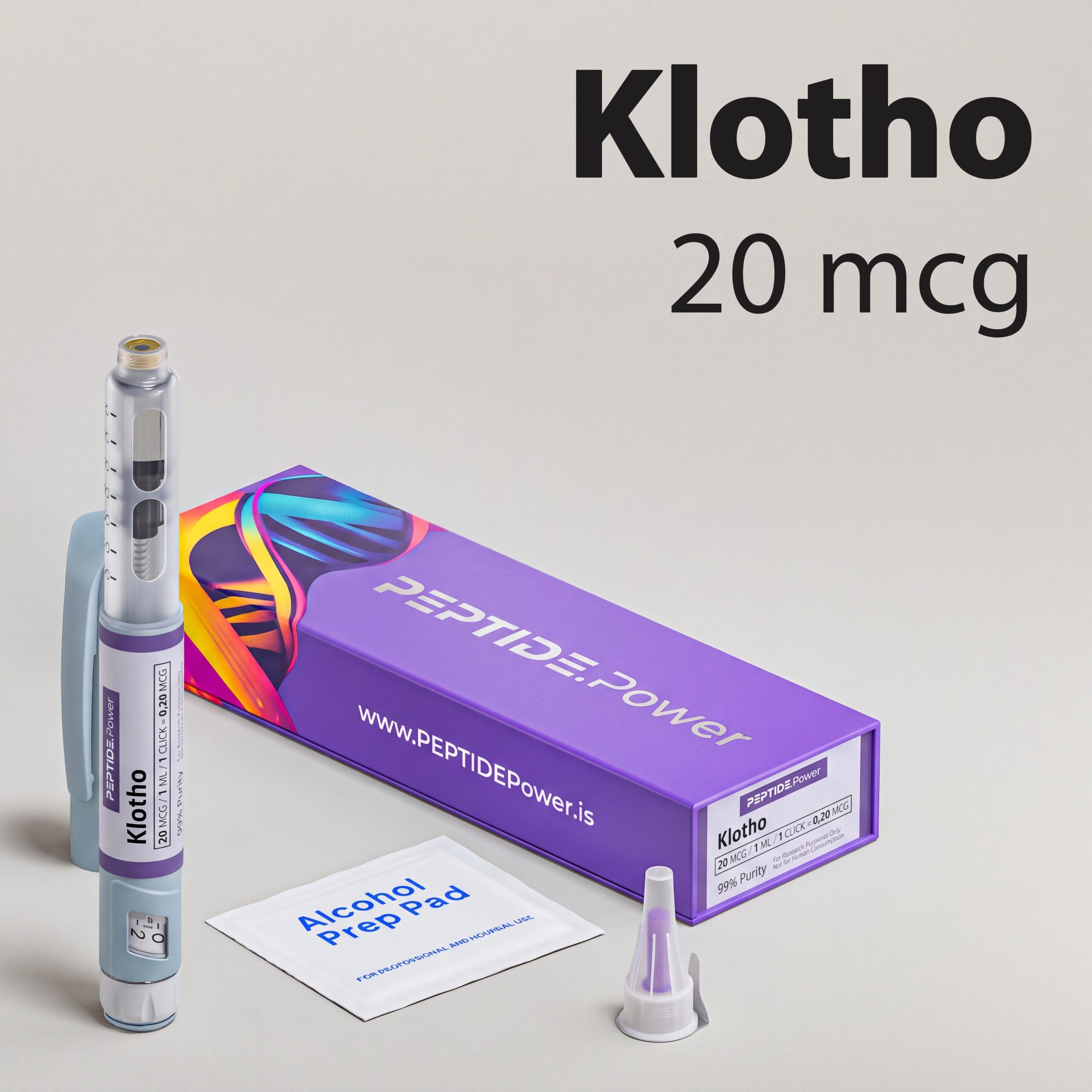
Klotho Research Peptide Pen (20 mcg)
Klotho is a research protein based on alpha-Klotho, a single-pass membrane protein that is also found as a shed, soluble form. It is studied as a co-receptor of FGF23 signalling and in mouse ageing models. This construct carries a C-terminal albumin-binding tail, and the supplier claims a long-release profile of up to 19 days. Supplied as a ready-to-use 20 mcg pen for laboratory research.
Klotho - alpha-Klotho Research Protein with Albumin-Binding Tail
Full-length alpha-Klotho carries two glycosyl hydrolase-like domains, KL1 and KL2, in its extracellular region
Studied as the partner that converts FGFR1c into a specific receptor for FGF23 in cell models
Shed extracellular alpha-Klotho is described as a non-enzymatic scaffold for FGF23 signalling
Klotho gene defects in mice were reported to produce an ageing-like syndrome in mouse studies
Overexpression in mice was reported to extend life span and repress insulin and IGF1 signals
Albumin-binding peptides related to SA21 extended a Fab fragment half-life in mice and rabbits
Supplier describes a long-release profile of up to 19 days, with no independent pharmacokinetic data
Human alpha-Klotho is a 1012-residue single-pass membrane protein, UniProt entry Q9UEF7
What is Klotho?
Description
What alpha-Klotho is. Human Klotho (UniProt Q9UEF7) is a 1012-residue single-pass membrane protein with a calculated, unglycosylated mass of 116181 Da. Its extracellular region holds two glycosyl hydrolase-like domains, KL1 (residues 57-506) and KL2 (residues 515-953), followed by a transmembrane segment and a short cytoplasmic tail. The klotho gene was first described in mice in 1997 as encoding a membrane protein that shares sequence similarity with beta-glucosidase enzymes. The extracellular domain can be shed from the membrane, and a structural study describes this shed alpha-Klotho as a non-enzymatic scaffold.
The construct. The product is a long-release alpha-Klotho construct. According to the supplier it is a soluble alpha-Klotho protein joined through a glycine-serine linker to a C-terminal albumin-binding tail (GGSGGSGGSGGRLIEDICLPRWGCLWEDD). The tail contains the SA21-type peptide RLIEDICLPRWGCLWEDD, an albumin-binding sequence described in 2002 for lengthening the half-life of proteins in animals. The exact boundaries and mass of the construct are not disclosed. It is not KP1 and not a short Klotho-derived fragment.
Supplier claim. The supplier states a long-release profile of up to 19 days. This is a supplier claim: no independent pharmacokinetic data are cited here.
Dosing note. No human dosing data exist for this product. The schedule shown in the dosage section is a conservative house research protocol built on the claimed long-release profile and the 20 mcg pen, and it is not a literature dose.
Storage and handling. Keep the pen as stated on its label and in the accompanying documentation and avoid repeated temperature cycling. For laboratory research use only.
Mechanism of Action
FGF23 co-receptor. In 2006 it was reported that Klotho binds FGF23 and enables high-affinity binding of FGF23 to the cell surface. Klotho alone appeared unable to signal inside the cell, and together with FGFR1(IIIc) it reconstituted the FGF23 receptor. In 2018 a structure of a 1:1:1 complex of the shed extracellular domain of alpha-Klotho, the FGFR1c ligand-binding domain and FGF23 was published. In it alpha-Klotho tethers FGFR1c through its D3 domain and FGF23 through its C-terminal tail, and its structure is incompatible with a glycosidase activity.
Insulin and IGF1 signalling. In a 2005 mouse study Klotho was described as a circulating hormone that binds a cell-surface receptor and represses intracellular insulin and IGF1 signals.
Albumin binding. Peptides with the core sequence DICLPRWGCLW bind serum albumin of several species. A related sequence fused to a Fab fragment reduced its clearance in mice and rabbits and extended its half-life. The tail of this construct is of the SA21 type; whether it behaves the same way in the full construct is a supplier claim.
Benefits
- Two-Domain Structure:
Full-length human alpha-Klotho (UniProt Q9UEF7) is annotated as a 1012-residue single-pass membrane protein. Its extracellular region holds two glycosyl hydrolase-like domains, KL1 (residues 57-506) and KL2 (residues 515-953), followed by a transmembrane segment and a short cytoplasmic tail. The klotho gene was first described in mice in 1997 as encoding a membrane protein with sequence similarity to beta-glucosidase enzymes. - FGF23 Co-Receptor:
In cell models, Klotho bound FGF23 and enabled high-affinity binding of FGF23 to the cell surface. Klotho alone appeared unable to signal inside the cell, and together with FGFR1(IIIc) it reconstituted the FGF23 receptor. In wild-type mice, an anti-Klotho monoclonal antibody induced FGF23 incompetence. This makes Klotho a useful tool for studying FGF23 signalling in research models. - Shed Scaffold Form:
A published atomic structure describes a 1:1:1 complex of the shed extracellular domain of alpha-Klotho, the FGFR1c ligand-binding domain and FGF23. In this complex alpha-Klotho tethers FGFR1c through its D3 domain and FGF23 through its C-terminal tail, while heparan sulfate remains a cofactor. The authors concluded that shed alpha-Klotho is a non-enzymatic scaffold, not a glycosidase. - Mouse Ageing Models:
In a 1997 mouse study, a defect in klotho gene expression produced a syndrome that resembles human ageing, including a short lifespan, infertility, arteriosclerosis, skin atrophy, osteoporosis and emphysema. The authors suggested that the klotho gene product may function in a signalling pathway that regulates ageing in vivo. This is animal data only and does not describe this product. - Insulin and IGF1 Signalling:
A 2005 mouse study reported that overexpression of Klotho extended life span. Klotho was described as a circulating hormone that binds a cell-surface receptor and represses intracellular insulin and IGF1 signals, and ageing-like phenotypes of Klotho-deficient mice were alleviated by perturbing insulin and IGF1 signalling. These are mouse findings only, and no human outcome is implied. - Albumin-Binding Tail:
This construct carries a C-terminal tail (GGSGGSGGSGGRLIEDICLPRWGCLWEDD) containing the SA21-type albumin-binding peptide RLIEDICLPRWGCLWEDD. In a 2002 animal study, peptides with the core sequence DICLPRWGCLW bound serum albumin of several species, and a related sequence fused to a Fab fragment extended its half-life 37-fold in rabbits and 26-fold in mice. Those data concern a Fab fragment, not this construct. - Long-Release Claim:
The supplier states that the construct has a long-release profile of up to 19 days. This is a supplier claim. No independent pharmacokinetic data are cited here, and the pen schedule is a house research protocol, not a literature dose. - Reference Protein Entry:
UniProt lists human alpha-Klotho under accession Q9UEF7, with a calculated, unglycosylated mass of 116181 Da for the full-length precursor. The exact mass and boundaries of the product construct are not disclosed. It is not KP1 and not a short Klotho-derived fragment, so the identity data refer to the parent protein.
Research data & references
Research Data
| Study / Model | Reported finding |
|---|---|
| Mouse klotho gene defect (Kuro-o 1997) | Syndrome resembling ageing, including short lifespan; the gene encodes a membrane protein similar to beta-glucosidases |
| Klotho overexpression in mice (Kurosu 2005) | Extended life span; Klotho described as a circulating hormone that represses insulin and IGF1 signals |
| Cell models and mice (Urakawa 2006) | Klotho with FGFR1(IIIc) reconstitutes the FGF23 receptor; an anti-Klotho antibody induced FGF23 incompetence in wild-type mice |
| Structural study (Chen 2018) | 1:1:1 complex of shed alpha-Klotho, FGFR1c and FGF23; shed alpha-Klotho acts as a non-enzymatic scaffold |
| Albumin-binding peptides (Dennis 2002) | SA21-type peptides bind serum albumin; a Fab fusion had a longer half-life in mice and rabbits |
| Human studies of this construct | None cited. The long-release profile of up to 19 days is a supplier claim |
Scientific References
- Kuro-o M et al. Nature 1997 Mouse genetics
- Kurosu H et al. Science 2005 Mouse study
- Urakawa I et al. Nature 2006 Cell and mouse study
- Chen G et al. Nature 2018 Structural study
- Dennis MS et al. J Biol Chem 2002 Albumin-binding peptides
- UniProtKB Q9UEF7 (KLOTH_HUMAN) Registry
Pen dosing chart & research protocols
Pen Dosage Chart
| Klotho Pen 20 mcg | |
|---|---|
| Volume | 1 mL |
| mcg/mL | 20 mcg/mL |
| Click-to-Dose | 1 click = 0.2 mcg |
| Example(s) | 10 clicks = 2 mcg |
Protocol variations
Low-dose research protocol
- Dose: 1 mcg (5 clicks)
- Duration: 40 weeks (one pen = 20 doses)
- Frequency: One dose every 14 days, subcutaneous (SubQ) with the pen
- Cycle Interval: Pause of at least 4 weeks before a repeat course
- Pen Coverage: 1 pen = 20 doses (one dose every 14 days)
- Goal / Description: Conservative entry dose of 5 clicks (1.0 mcg), kept constant. No human dosing data exist for this product. The schedule is a conservative house research protocol based on the claimed long-release profile (up to 19 days per the supplier) and the 20 mcg pen; it is not a literature dose.
Titration research protocol
- Dose: 1 - 2 mcg (5 - 10 clicks)
- Duration: 5 clicks (1.0 mcg) for the first 4 doses, then 10 clicks (2.0 mcg)
- Frequency: One dose every 14 days, subcutaneous (SubQ) with the pen
- Cycle Interval: Pause of at least 4 weeks before a repeat course
- Pen Coverage: 1 pen = 20 - 10 doses (one dose every 14 days)
- Goal / Description: Gradual step from 1.0 mcg to 2.0 mcg; one pen = 20 doses at 5 clicks or 10 doses at 10 clicks. No human dosing data exist for this product. The schedule is a conservative house research protocol based on the claimed long-release profile (up to 19 days per the supplier) and the 20 mcg pen; it is not a literature dose.
Standard research protocol
- Dose: 2 mcg (10 clicks)
- Duration: 20 weeks (one pen = 10 doses)
- Frequency: One dose every 14 days, subcutaneous (SubQ) with the pen
- Cycle Interval: Pause of at least 4 weeks before a repeat course
- Pen Coverage: 1 pen = 10 doses (one dose every 14 days)
- Goal / Description: Upper house dose of 10 clicks (2.0 mcg), kept constant. No human dosing data exist for this product. The schedule is a conservative house research protocol based on the claimed long-release profile (up to 19 days per the supplier) and the 20 mcg pen; it is not a literature dose.
Stack Suggestions
No stack is offered for Klotho in this catalogue:
- Klotho alone: the cited studies evaluated Klotho on its own, in cell and mouse models.
- Combination designs: no validated combination partner is offered here.
Note: any combination is for experimental design only and is not safety or efficacy guidance.
Safety notes
Klotho in this form is a research material. No human safety data exist for this construct, and none of the cited papers reports human exposure to it.
For research context:
- The cited findings come from cell models, structural work and mouse studies.
- The albumin-binding tail comes from a 2002 animal study of a Fab fragment, not from this construct.
- Handle only under laboratory research conditions. Not for human or veterinary use.
Specifications
- CAS #: N/A
- Molecular Formula: N/A
- Sequence (AA): N/A
- Molecular Weight: 116181 Da (calculated, unglycosylated, full-length precursor)
- PubChem CID: N/A
- Half-Life: Claimed long-release profile, up to 19 days per the supplier; no independent pharmacokinetic data
- Synonyms: alpha-Klotho, Klotho, KL, KLOTH_HUMAN
- Type: Recombinant research protein (alpha-Klotho, long-release construct)
- Research Focus: Anti-ageing membrane protein and co-receptor of FGF23/FGFR1c; studied in mouse ageing models and FGF23 signalling
- C-terminal albumin-binding tail: GGSGGSGGSGGRLIEDICLPRWGCLWEDD
Included In The Box
Every product arrives in a premium, custom-designed PEPTIDE.Power box, engineered for convenience, hygiene, and safe storage in your refrigerator. Inside, you will find everything needed for your full research protocol:
- 1× Disposable Pre-Mixed Injection Pen
- Powered by our proprietary PSM Technology™: precision stabilization & mixing system for consistent potency
- 10× Ultra-thin Needles (33G, 4 mm)
- 10× Alcohol Pads for sterile preparation
- Internal Stabilizing Foam Insert to prevent shaking during transport
- Instruction Panel printed on the inside of the box for quick reference
- Security Seal Sticker ensuring the package has not been opened or tampered with
Storage
Store the product in a refrigerator at 1-8°C immediately upon delivery. To maintain optimal stability, keep the pen away from light, and do not expose it to repeated temperature changes.
Once reconstituted (all our pens come pre-mixed), research compounds remain stable for 6-8 weeks under proper refrigeration.
Do not freeze after reconstitution. Always keep the box closed so the pen, needles, and alcohol pads stay clean and protected.
For best results, use the product consistently within the recommended time window and always follow your research protocol.
Delivery
We ship with Next-Day EU Delivery via DHL Express or UPS Express.
All orders are prepared fresh on the day of dispatch, placed in EPS Cold-Chain Transport Boxes, and shipped with cooling elements to maintain a stable temperature throughout the journey.
Our logistics process is designed so the package arrives overnight, avoiding customs delays inside the European Union.
Products are shipped from our EU facility, ensuring no import duties, no customs clearance, and always fast and secure delivery.
Payment
Due to the nature of research peptides and the high-risk category assigned by payment processors, credit card companies do not generally support merchants in this field.
For this reason, we accept mainly Bank Transfers.
We also work with a crypto payment provider, and from time to time, card payments may be available depending on processor availability.
Within the European Union, SEPA transfers are fast, low-cost, and usually arrive within minutes to a few hours, making the payment process smooth and simple.
Once the transfer is received, your order is prepared immediately and dispatched the same day, depending on the daily cut-off time.
Please note that we do not dispatch shipments on Fridays or on days before official public holidays. This is done to ensure that parcels can be delivered on the next working day and are not held in transit over weekends or holidays.
This method ensures compliance, security, and continuity of service for all customers across the EU.
Didn't find the answer to your question?
View all frequently asked questions


