

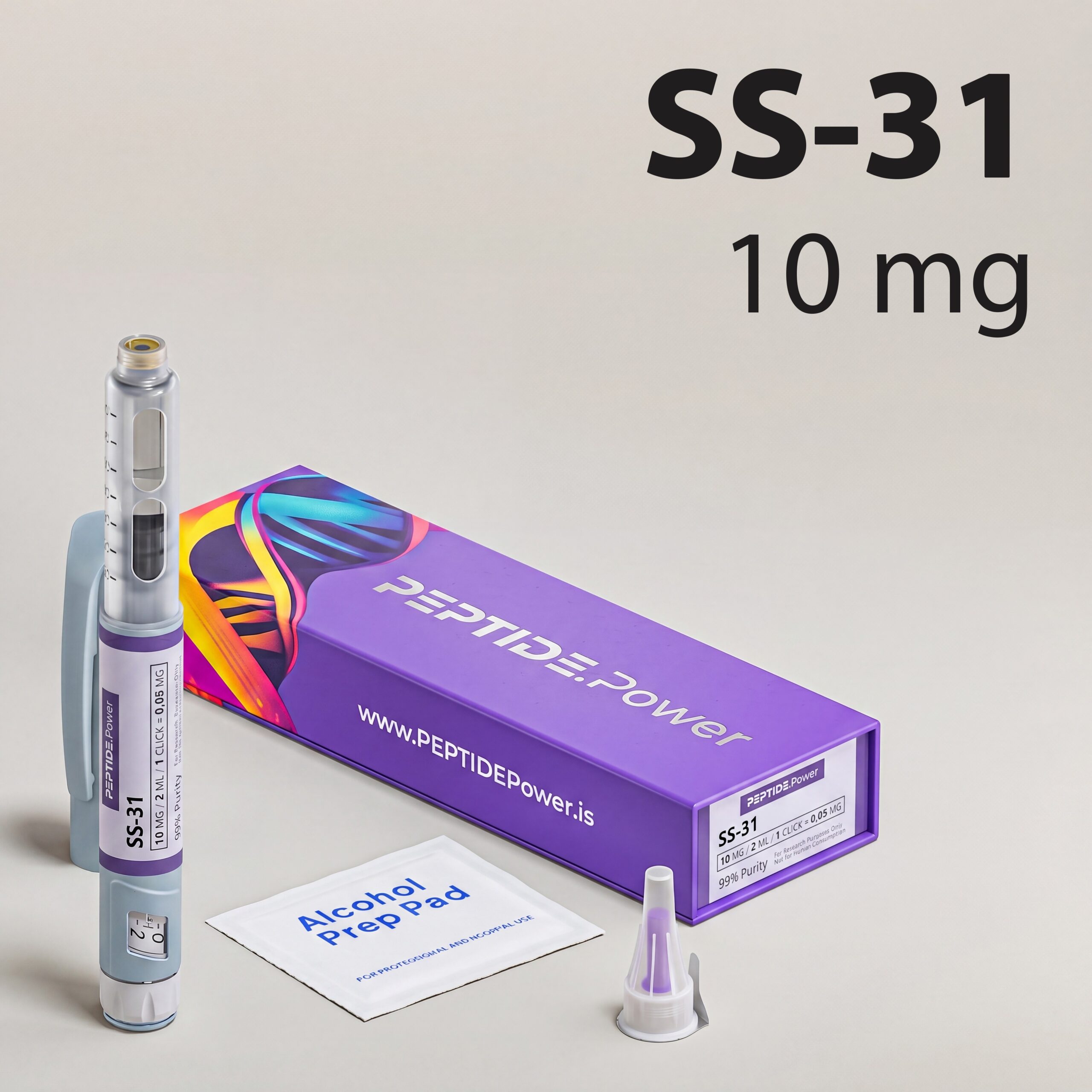


SS-31
SS-31 (Elamipretide) is a mitochondria-targeting peptide studied for its role in cellular energy production and oxidative stress modulation. In preclinical and early clinical studies, it has been observed to interact with cardiolipin within the inner mitochondrial membrane. Subcutaneous administration allows targeted mitochondrial support and bioenergetic optimization in research models. Formulated in a stabilized pre-mixed injection pen for research use only.
$89.99
Quality Certificates
Independent third-party lab analysis (CoA) - from our own in-house brand.
📦Available in 2 stacks · save up to $194.95
Cell Renewal - Advancedsave $193.95View the stack →Energy - Advancedsave $194.95View the stack →SS-31 (Elamipretide) - Mitochondrial Protection & Cellular Energy
Targets inner mitochondrial membrane stability
Supports efficient cellular energy synthesis
Reduces mitochondrial oxidative stress
Studied in cardiometabolic models
Evaluated in muscle and nerve models
Stabilizes mitochondrial respiration
Supports mitochondrial structural integrity
Binds cardiolipin to stabilize the inner mitochondrial membrane
Description
SS-31 (Elamipretide) is a mitochondria-targeting tetrapeptide developed to support mitochondrial membrane stability and bioenergetic function in research settings. It belongs to a class of cell-penetrating peptides designed to localize within the inner mitochondrial membrane. SS-31 has been studied primarily in domains such as mitochondrial dysfunction, aging biology, cardiometabolic research, and neuromuscular models. In experimental systems, it has been observed to influence ATP production and reactive oxygen species balance.
Our formulation is provided in a stabilized pre-mixed injection pen for SubQ administration. Subcutaneous delivery supports consistent systemic exposure and high mitochondrial bioavailability in research protocols. Each unit is freshly prepared to preserve peptide integrity and ensure standardized dosing. This format eliminates multi-step vial preparation and supports simplified laboratory handling. The product is formulated strictly for research use only.
In research models, SS-31 has been observed to bind cardiolipin, a phospholipid unique to the inner mitochondrial membrane. This interaction appears to stabilize electron transport chain function → ↑ ATP synthesis efficiency and ↓ oxidative stress markers. Preclinical data show improved mitochondrial respiration and reduced mitochondrial swelling under stress conditions. Early human studies have explored its effects in mitochondrial-related dysfunction models.
Clinical Status
Human RCT ✔ | Observational ✔ | Animal ✔ | In vitro ✔
Evaluated in human clinical trials for mitochondrial and cardiovascular research indications.
Mechanism of Action
SS-31 works by targeting and stabilizing mitochondria, the energy-producing structures inside cells. In research models, it selectively binds to cardiolipin in the inner mitochondrial membrane. This stabilizes electron transport chain complexes → ↑ ATP production efficiency. Studies indicate ↓ mitochondrial reactive oxygen species (ROS) generation under stress conditions. These effects support improved cellular energy dynamics in experimental systems.
Benefits
- Mitochondrial Membrane Stabilization:
SS-31 has been studied for its selective binding to cardiolipin within the inner mitochondrial membrane. Research suggests this interaction stabilizes mitochondrial cristae structure. Improved membrane integrity supports optimized electron transport chain function. Preclinical studies indicate enhanced mitochondrial efficiency under stress conditions. These findings position SS-31 as a central peptide in mitochondrial biology research. - Enhanced ATP Production Efficiency:
In experimental models, SS-31 has been observed to improve oxidative phosphorylation dynamics. Studies demonstrate ↑ ATP synthesis efficiency through stabilization of respiratory chain complexes. This appears to support improved cellular energy availability. Animal research documents enhanced mitochondrial respiration rates. Evidence spans in vitro, animal, and early-stage human data. - Reduction Of Mitochondrial Oxidative Stress:
SS-31 has been associated with ↓ mitochondrial reactive oxygen species production in laboratory models. Reduced electron leak from the respiratory chain has been documented. This contributes to lower oxidative damage within mitochondria. Preclinical data show improved mitochondrial membrane potential under oxidative stress conditions. - Cardiometabolic Research Applications:
The peptide has been evaluated in cardiac and metabolic research contexts. Animal studies suggest improved mitochondrial function in cardiac tissue models. Enhanced myocardial bioenergetics has been documented. Early human trials have explored its effects in mitochondrial-related dysfunction studies. - Neuromuscular And Muscle Function Research:
SS-31 has been studied in skeletal muscle and neuromuscular models. Research indicates improved mitochondrial density and respiratory capacity in animal systems. Enhanced muscle bioenergetics has been observed under stress conditions. These findings remain within controlled research environments. - Electron Transport Chain Optimization:
By stabilizing cardiolipin, SS-31 supports optimal assembly of respiratory supercomplexes. This leads to improved electron flow → ↑ oxidative phosphorylation efficiency. Laboratory measurements demonstrate enhanced mitochondrial membrane potential. Evidence type: Animal ▣ | In vitro ▣. - Cellular Energy Resilience:
In models of metabolic stress, SS-31 has been observed to preserve mitochondrial function. Improved bioenergetic stability has been measured during oxidative challenge experiments. This regulatory effect supports cellular resilience in research contexts. - High Bioavailability Through Subcutaneous Administration:
Provided in a stabilized pre-mixed injection pen for SubQ administration, supporting consistent experimental dosing. Subcutaneous delivery enables reliable systemic exposure in research models. Each unit is prepared fresh and intended strictly for laboratory use.
Research Data
| Study / Model | Reported effect |
|---|---|
| Aged mouse skeletal muscle | ↑ ATP production, ↓ oxidative damage, improved mitochondrial coupling efficiency |
| Ischemia-reperfusion cardiac model | ↓ infarct size, preserved mitochondrial cristae structure and membrane potential |
| Primary mitochondrial myopathy (clinical) | Improved 6-minute walk distance and reduced patient-reported fatigue |
| Diabetic nephropathy rodent model | ↓ renal oxidative stress, preserved glomerular function and tubular integrity |
| Heart failure (HFrEF) early trials | Trends toward improved left ventricular function and exercise tolerance |
| In vitro cardiolipin-binding assays | Selective localization to inner mitochondrial membrane, stabilized ETC complexes |
| Age-related macular degeneration trials | Improved low-luminance visual acuity and retinal function markers |
Stack Suggestions
SS-31 is often combined in research with:
- SS-31 + NAD+ → Supports mitochondrial bioenergetics and cellular energy metabolism.
- SS-31 + BPC-157 → Combines mitochondrial protection with tissue regeneration pathways.
- SS-31 + MOTS-c → Synergistic mitochondrial function and metabolic regulation in research models.
- SS-31 + Glutathione → Enhances antioxidant defense and reduces oxidative stress markers.
⚠ Stacks are for experimental design only; not safety or efficacy guidance.
Pen Dosage Chart
| SS-31 Pen 10 mg | |
|---|---|
| Volume | 2 mL |
| mg/mL | 5 mg/mL |
| Click-to-Dose | 1 click = 0.05 mg |
| Example(s) | 10 clicks = 0.5 mg |
Dosage & Protocols Variations
Standard Research Protocol
- Dose: 1 – 5 mg (= 20–100 clicks)
- Duration: 4 – 8 weeks
- Frequency: Daily (subcutaneous)
- Cycle Interval: 2 – 4 weeks off before repeating
- Goal / Description: Baseline mitochondrial support and cardiolipin stabilization in research models.
Therapeutic Research Protocol
- Dose: 5 – 10 mg (= 100–200 clicks)
- Duration: 6 – 12 weeks
- Frequency: Daily
- Cycle Interval: 4 weeks off before repeating
- Goal / Description: Higher-dose protocol for models focused on cardiac, renal, or neurodegenerative mitochondrial dysfunction.
Biohacker Protocol (experimental)
- Dose: 0.5 – 1 mg (= 10–20 clicks)
- Duration: 8 – 12 weeks
- Frequency: Daily microdose
- Cycle Interval: Continuous with periodic 1 – 2 week pauses
- Goal / Description: Low-dose continuous exposure for longevity and oxidative-stress modulation studies.
Stacked Protocol (SS-31 + MOTS-c)
- Dose: 3 – 5 mg SS-31 + 5 mg MOTS-c (= 60–100 clicks)
- Duration: 4 – 6 weeks
- Frequency: Daily
- Cycle Interval: 4 weeks off before repeating
- Goal / Description: Combined mitochondrial biogenesis and membrane stabilization in metabolic research models.
Possible Side Effects
SS-31 (Elamipretide) has been generally well-tolerated in preclinical and early clinical research settings, with no severe adverse effects reported in available data.
Mild and transient effects observed in research include:
- Localized injection-site reactions, including redness, mild swelling, or irritation.
- Transient headache or dizziness during initial dosing periods.
- Mild gastrointestinal discomfort or nausea in sensitive subjects.
- Occasional fatigue or lightheadedness shortly after administration.
No evidence of hepatic, renal, or hormonal adverse effects has been observed in available research data. Long-term safety profiles remain under investigation in ongoing studies focused on mitochondrial-targeted therapeutics.
Product Attributes
- CAS #: 736992-21-5
- Molecular Formula: C32H49N9O5
- Sequence (AA): D-Arg-Dmt-Lys-Phe-NH2
- Molecular Weight: 639.8 g/mol
- PubChem CID: 11764719
- Half-Life: ~2-4 hours
- Synonyms: Elamipretide, MTP-131, Bendavia, SS-31 Peptide
- Type: Synthetic mitochondria-targeting tetrapeptide
- Research Focus: Mitochondrial Function, Cellular Energy & Oxidative Stress
Scientific References
- Szeto-Schiller Peptides: Mitochondrial-Targeted Peptides for the Treatment of Mitochondrial Disease Animal | In vitro
- Cardiolipin and mitochondrial cristae organization In vitro | Animal
- First-in-class cardiolipin-protective compound as a therapeutic agent to restore mitochondrial bioenergetics Animal | In vitro
- Elamipretide (SS-31) Improves Mitochondrial Dysfunction, Synaptic and Memory Impairment Animal
- Elamipretide Improves Mitochondrial Function in the Skeletal Muscle of Older Individuals Human RCT
- Mitochondrial-targeted peptide SS-31 attenuates oxidative stress and renal injury Animal | In vitro
- SS-31, a Mitochondria-Targeting Peptide, Ameliorates Kidney Disease Animal
- Cardiolipin-targeted peptides rejuvenate mitochondrial function in aged cells In vitro | Animal
Included In The Box
Every product arrives in a premium, custom-designed PEPTIDE.Power box, engineered for convenience, hygiene, and safe storage in your refrigerator. Inside, you will find everything needed for your full research protocol:
- 1× Disposable Pre-Mixed Injection Pen
- Powered by our proprietary PSM Technology™ – precision stabilization & mixing system for consistent potency
- 10× Ultra-thin Needles (33G, 4 mm)
- 10× Alcohol Pads for sterile preparation
- Internal Stabilizing Foam Insert to prevent shaking during transport
- Instruction Panel printed on the inside of the box for quick reference
- Security Seal Sticker ensuring the package has not been opened or tampered with
Storage
Store the product in a refrigerator at 1 – 8°C immediately upon delivery. To maintain optimal stability, keep the pen away from light, and do not expose it to repeated temperature changes.
Once reconstituted (all our pens come pre-mixed), research compounds remain stable for 6 – 8 weeks under proper refrigeration.
Do not freeze after reconstitution. Always keep the box closed so the pen, needles, and alcohol pads stay clean and protected.
For best results, use the product consistently within the recommended time window and always follow your research protocol.
Delivery
We ship with Next-Day EU Delivery via DHL Express or UPS Express.
All orders are prepared fresh on the day of dispatch, placed in EPS Cold-Chain Transport Boxes, and shipped with cooling elements to maintain a stable temperature throughout the journey.
Our logistics process is designed so the package arrives overnight, avoiding customs delays inside the European Union.
Products are shipped from our EU facility, ensuring no import duties, no customs clearance, and always fast and secure delivery.
Payment
Due to the nature of research peptides and the high-risk category assigned by payment processors, credit card companies do not generally support merchants in this field.
For this reason, we accept mainly Bank Transfers.
We also work with a crypto payment provider, and from time to time, card payments may be available depending on processor availability.
Within the European Union, SEPA transfers are fast, low-cost, and usually arrive within minutes to a few hours, making the payment process smooth and simple.
Once the transfer is received, your order is prepared immediately and dispatched the same day, depending on the daily cut-off time.
Please note that we do not dispatch shipments on Fridays or on days before official public holidays. This is done to ensure that parcels can be delivered on the next working day and are not held in transit over weekends or holidays.
This method ensures compliance, security, and continuity of service for all customers across the EU.
Didn't find the answer to your question?
View all frequently asked questionsRELATED PRODUCTS

ARA-290 (Cibinetide)

CJC-1295 (No-DAC) + Ipamorelin

Epithalon


GLP-3R


